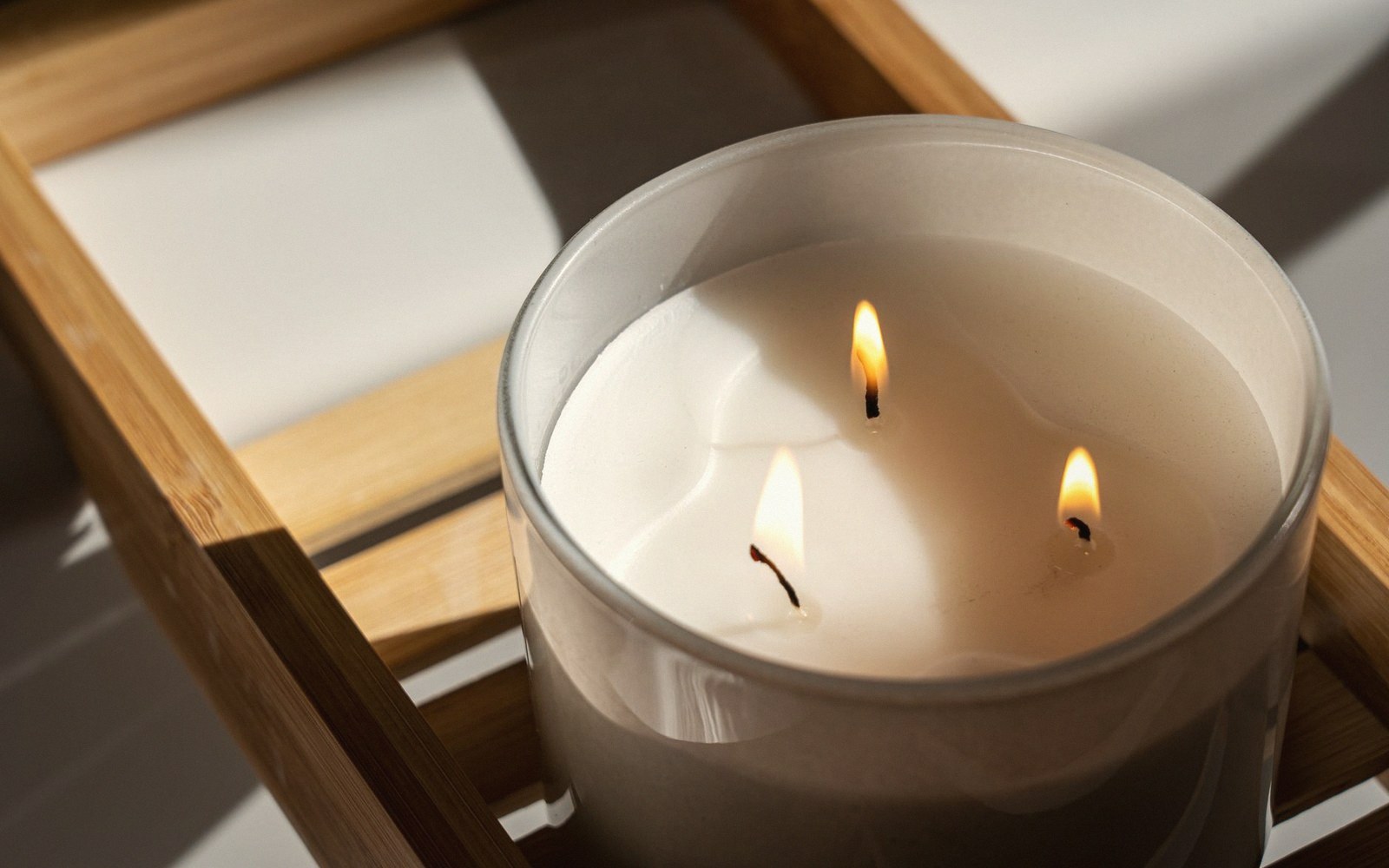
Three Waxes, One Container, One Wick
Lock the vessel, the wick, and the fragrance load — and suddenly what the wax actually does becomes visible. Here is what paraffin, soy, and coconut wax look like under genuinely identical conditions.
The Setup, and Why It Matters
Most candle comparisons are useless because they compare products that differ in five variables at once: different vessels, different wick sizes, different fragrance percentages, different rooms. Any difference you observe could belong to any of those variables, and probably does. The only way to isolate what wax actually contributes is to hold everything else still.
So: one container — a straight-sided glass jar, wide enough that wick size is not a limiting factor — one wick, centred, of identical construction and diameter, and a fragrance load of ten percent by weight, the same fragrance compound in each pour. The paraffin used is a mid-blend container wax, the kind behind most commercial jar candles. The soy is a fully hydrogenated soybean wax, the category standard for the cottage and indie market. The coconut wax is refined, bleached, and lightly fractionated, the form most often used in luxury container candles. Each variable after those three is as close to constant as wax-making permits.
What follows is what those waxes actually do — in terms of melt pool behaviour, scent delivery, surface appearance, and longevity — and what those differences mean for someone on the burning end.
Paraffin: Fast, Bright, Unfairly Maligned
Paraffin reaches a full melt pool faster than either of the alternatives, in a vessel of this width, typically within the first hour of the first burn. That speed is a function of paraffin's lower viscosity in liquid form: it flows readily, the melt pool spreads efficiently, and the wax close to the vessel wall liquefies before it has the chance to build the hard rim that causes tunnelling. This is not a mark against soy or coconut — it reflects paraffin's different thermal properties — but it does mean that in a straight-sided jar, paraffin is forgiving of a slightly under-sized wick in a way the other two are not.
The hot throw from paraffin is typically strong and arrives quickly. This is partly because paraffin's lower melting point means the melt pool forms early and stays warm enough to volatilise fragrance efficiently, and partly because paraffin carries fragrance well — its molecular structure is generally hospitable to both synthetic and natural fragrance compounds. You notice this in the first twenty minutes: the scent declares itself. Whether that early arrival sustains through a long burn session is another question, and one that has more to do with olfactory fatigue than with the wax running out of fragrance to give.
Paraffin burns hotter overall, which has a visible consequence: the flame tends to be larger and more active, and over a long burn, a larger wick may develop the carbon mushrooming that signals incomplete combustion at the tip. In this test, with a wick sized honestly for the vessel, that mushrooming is present but modest. The surface of the cooled candle is smooth and slightly glossy — paraffin contracts cleanly as it cools, and while some small surface imperfections are possible on a repour, a well-made paraffin candle looks controlled and intentional. What it rarely looks like is handmade, which is partly why some makers have moved away from it regardless of its technical performance.
The honest summary of paraffin: it does most things well, performs consistently, and has been the industry standard for a long time for reasons that have nothing to do with marketing.
Soy: Slower, Cooler, Genuinely Different
Soy wax in the same vessel and with the same wick takes noticeably longer to reach a full melt pool. The wax is denser in liquid form and has a higher viscosity, which means it does not spread as readily across the surface. In a wide-diameter vessel this can mean the edges remain solid — a thin unmelted ledge — for the first burn or two. This is not automatically a sign that something has gone wrong; soy has a wider plastic range as it cools, meaning there is a window of soft, pliable wax between fully liquid and solid that paraffin passes through more quickly. What this also means is that soy is less forgiving of an under-sized wick than paraffin is. The wick has to work harder to generate the heat needed to push the melt pool to the jar wall.
The hot throw from soy takes longer to develop. The melt pool needs to be fully liquid before fragrance volatilises efficiently, and because soy runs cooler, it takes more burn time to reach that point. Once it gets there, the throw is present and clear, but it arrives differently — later in the burn session, and often at a lower peak intensity than paraffin in the same conditions. Some people prefer this: it feels less aggressive, less like being hit immediately with scent. Others simply think the candle is not working. The difference in expectation is real, and if you have only ever burned paraffin candles, a well-made soy candle may read as underperforming when it is simply behaving differently.
The surface of cooled soy wax is where things get interesting and where a lot of marketing copy goes quietly wrong. Soy contracts unevenly and is prone to frosting — a whitish, crystalline bloom on the surface — and to wet spots where the wax pulls away from the glass as it solidifies. Neither of these defects affects performance, but both are common, and makers who tell you they are desirable natural characteristics are making a virtue of a limitation. Some soy blends are formulated specifically to reduce these effects; fully natural, unblended soy will show them.
Soy also has a genuinely slower burn rate in this configuration. The candle lasts longer than its paraffin equivalent by a meaningful margin, which matters if you are working out value per hour of burn time rather than value per jar. This is one of the few soy claims that holds up under scrutiny.
Coconut Wax: The Quietest Performer
Coconut wax is the least familiar of the three to most buyers, partly because it is the most expensive raw material of the group and partly because it has reached the market largely through the premium end of the independent candle sector rather than through mass retail. Its physical properties sit in an interesting position relative to the other two: it is softer than soy at room temperature — soft enough, in some formulations, to dent with a thumbnail — and it has a lower melt point than either paraffin or soy, which affects everything downstream.
In this vessel, coconut wax produces a melt pool that is wide, deep, and slow to form a full surface skin on cooling. The liquid wax is highly fluid — more so than soy — which means the melt pool spreads easily and the wax loses heat to the vessel wall efficiently. The result is a burn that looks generous: the melt pool reaches the edges of a moderately wide jar in good time, and the flame sits steadily without dramatic fluctuation. In terms of pool behaviour, coconut wax in a container is arguably the most visually even of the three.
The hot throw from coconut wax is notably smooth. The low melt point means fragrance begins to volatilise earlier in the burn than with soy, and because coconut wax is a particularly good carrier for fragrance — its fatty acid composition allows it to bind fragrance compounds effectively — the scent delivery is even across the burn rather than front-loaded. It does not hit you immediately the way paraffin can. It does not take as long to arrive as soy often does. It sits somewhere between the two in timing and, in this configuration, is the most consistently present through a long burn session.
The surface of coconut wax after cooling is typically smooth, slightly creamy in appearance, and free from the frosting that marks soy. It can show a slight unevenness if poured at the wrong temperature, but it does not develop wet spots against the glass the way soy does. Aesthetically, it is the most reliable of the three, which is part of why it became a favourite for candles where presentation matters.
Its weakness is structural. At room temperature in a warm environment — a shelf near a south-facing window in summer, a heated showroom — coconut wax can soften visibly, even slump. The jar contains it, but the candle looks like something has gone wrong. Nothing has, technically, but the impression it creates is of a lower-quality product. Makers who use coconut wax in transport and display conditions that do not account for this find it a recurring headache.
What the Comparison Actually Tells You
Hold the vessel, wick, and fragrance constant, and the wax differences that remain are real but not enormous. Paraffin performs with consistency and speed. Soy burns longer and more slowly, with fragrance that takes time to develop. Coconut wax delivers the most even and visually smooth result but is the least physically robust before and after burning. None of the three is straightforwardly better than the others. Each performs differently, under these identical conditions, in ways that suit different priorities. Understanding which priority is yours is most of the work.