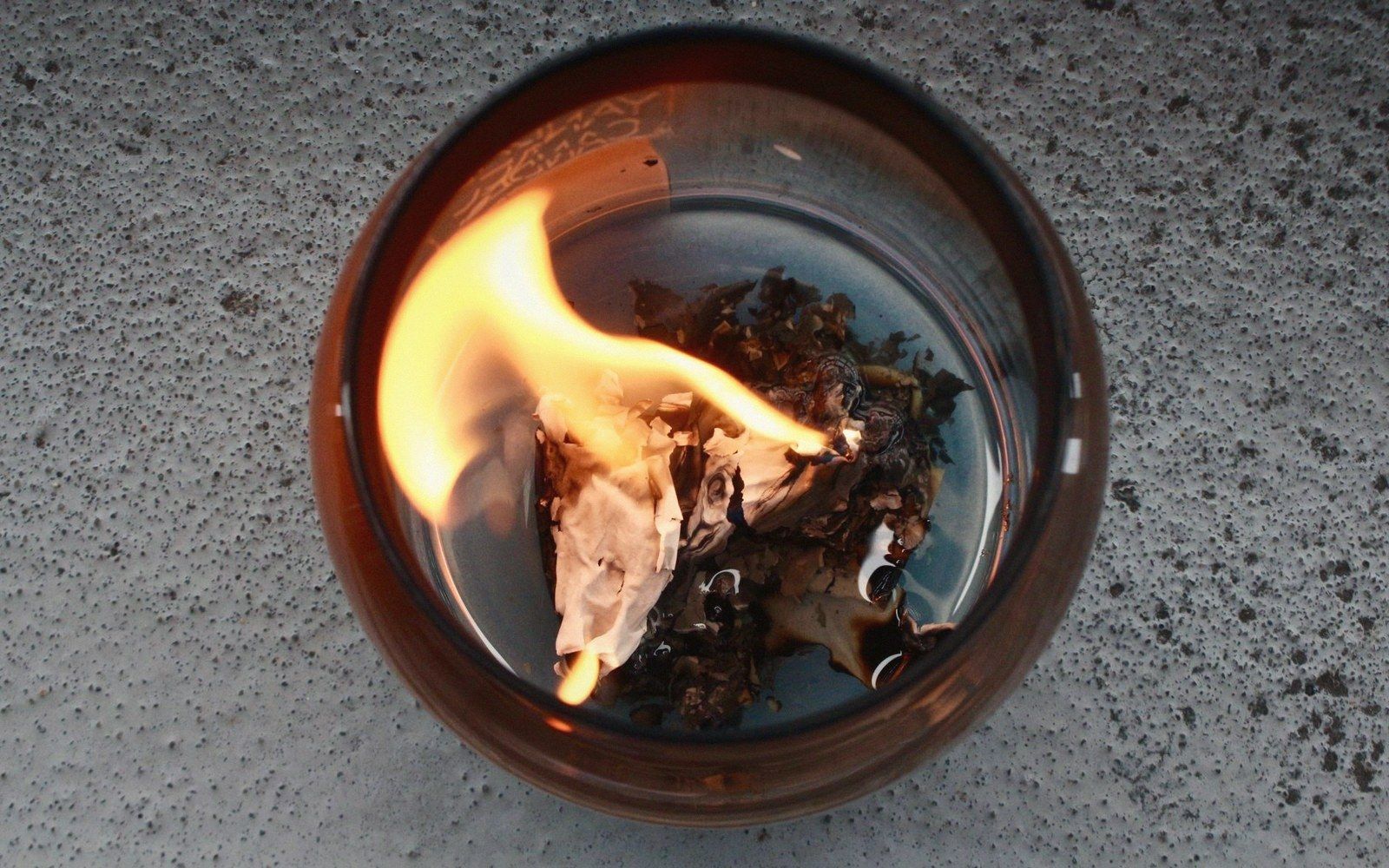
How to Read a Melt Pool
The disc of liquid wax around a burning wick is the most honest thing about a candle — here is what it is actually telling you.
The Pool as Diagnostic Tool
Most people look at a burning candle and see the flame. The useful thing to watch is the wax. That shallow disc of liquid sitting around the wick — the melt pool — is a live readout of how the candle is performing, and once you know what to look for, it is almost impossible to stop reading it.
The melt pool forms because a candle flame is, at its core, a fuel-delivery cycle. The wick draws liquid wax upward by capillary action, vaporises it at the flame, and the heat radiating downward and outward keeps a zone of wax liquid around the base. The diameter and depth of that zone at any given moment reflects the balance between heat output, wax type, vessel geometry, and wick sizing. Tip that balance in any direction and the pool changes shape. Read the shape and you can usually work out what went wrong — or confirm that nothing has.
A good melt pool in a well-made candle reaches edge to edge across the vessel — what candlemakers call a full melt pool — but not immediately. In the first thirty minutes of a burn, a partial pool is completely normal. Wax is a slow conductor of heat, and the melt front moves outward gradually as the surrounding wax warms. The question is not whether the pool is full at twenty minutes; it is whether it reaches the vessel wall within a reasonable window, and what it looks like when it gets there.
Tip that balance in any direction and the pool changes shape. Read the shape and you can usually work out what went wrong — or confirm that nothing has.
What Good Looks Like, Stage by Stage
The first ten to fifteen minutes of a burn are the least diagnostic. The wick is still warming, the wax immediately around the base is the first to yield, and the pool will look small and deep relative to where it will eventually settle. This is normal. The flame may flicker as it finds its footing, particularly if the wick was not trimmed before lighting. What you should not see at this early stage is a wick that is already drowning — sitting in a pool so deep that the liquid wax climbs up the cotton and the flame starts to enlarge and gutter. That is a wick too large for the vessel, working too hard from the first minute.
By the thirty-minute mark, the pool should be spreading visibly. In a well-sized candle — one where the maker has matched wick to wax and vessel with care — the pool typically reaches the wall of the container somewhere between forty-five minutes and two hours, depending on the vessel diameter. A narrow jar will pool out faster than a wide tin; that is geometry, not a quality difference. What matters is the trajectory. If the pool is still a tight circle around the wick at the ninety-minute mark of a standard container candle, something is restricting it.
Depth is as important as diameter, and it is the dimension most people ignore. A healthy melt pool is liquid all the way through — you are not looking for a particular measurement, but for consistency. Tilt the candle very slightly (carefully, and only when the surface is fully liquid) and the pool should move as a single fluid body. If there is a soft or mushy zone beneath what looks like a liquid surface, the wax is only partially melted — a condition sometimes called a false pool, where the heat has softened but not fully liquefied the wax below. A false pool can look fine from above and still indicate that the wick is undersized or that a dense wax with a high melt point is defeating it.
A full, even, properly deep pool after a full burn cycle — roughly the time it takes to reach the vessel wall — is the baseline against which everything else is measured. If you have that, the candle is functioning as intended. Everything else is deviation, and deviation has causes.
What a Shallow or Uneven Pool Is Telling You
A pool that stops short of the vessel wall — consistently, across multiple burns — is the classic sign of an undersized wick. The wick is generating enough heat to melt the wax around it but not enough to push the melt front outward across the full diameter. The practical result is tunnelling: a cylinder of melted wax burns down through the centre while a ring of unmelted wax builds up around the outside and never gets used. That ring is not a flaw in the wax; it is stranded fuel, and the candle will burn for a shorter time and throw less scent than it should, because fragrance is released most effectively from a full liquid pool.
The opposite problem — a pool that reaches the wall very quickly, runs unusually deep for its stage of burn, and produces a large, dancing flame — suggests an oversized wick. Here the wick is generating more heat than the wax and vessel combination requires, accelerating fragrance burn-off, potentially scorching the wax near the wick, and in some cases beginning to overheat the vessel. A glass jar that becomes uncomfortable to touch on its outer surface after a short burn is often running an oversized wick. The melt pool in this case is not a sign of health; it is a sign of excess.
Uneven pools — liquid on one side, solid or barely soft on the other — have a different set of causes. Draught is the first thing to check. Even a gentle, barely perceptible air movement across a candle will push the flame to one side, concentrate the heat asymmetrically, and produce a pool that reflects it. Where a candle sits in a room matters more than people think; a candle placed near a door that opens and closes periodically will rarely produce an even pool. A wick that has bent or curled toward one side of the vessel can do the same thing — the heat concentrates where the flame sits, and the opposite side stays cool. This is one reason trimming and straightening the wick between burns is worth the thirty seconds it takes.
Uneven pools can also point to inconsistency in the wax itself. A candle that was poured at the wrong temperature may have fragrance oil or additives distributed unevenly through the wax, creating zones with slightly different melt characteristics. This is a manufacturing variable rather than a use variable — the candle arrived with the problem, and the melt pool is revealing it.
Depth, Diameter, and the Wick Sizing Relationship
The melt pool is, in one sense, a visual proxy for wick sizing — which is itself one of the more technically demanding decisions in candle manufacture. Wick sizing involves matching the burn rate of the wick to the melt characteristics of the wax and the diameter of the vessel. When that match is right, the melt pool confirms it. When it is wrong, the pool shows you how and in which direction.
A useful rule of thumb: the depth of a mature melt pool should be roughly proportional to the overall height of the candle rather than fixed at a particular number. A deep pool in a tall candle and a shallow pool in a short candle may represent the same wick performing consistently across different fill levels. What you are watching for is not a single correct depth but a consistent one — a pool that behaves the same way on the third burn as on the first, at the same stage of that burn. Consistency is the sign of a wick properly matched to its wax.
Fragrance loading can shift this relationship. A candle with a heavy fragrance load — wax that contains a high proportion of fragrance oil — has a wax with slightly different viscosity and melt behaviour than the unfragranced base. Makers who test their wicks without fragrance and then add it at full load can find the pool behaves differently in the finished candle than in the prototype. A conscientious maker accounts for this in testing; a rushed one does not, and the buyer finds out in the melt pool. Similarly, certain fragrance families — particularly those built on heavier, resinous bases — can affect how freely the liquid wax moves and how quickly the melt front advances. A pool that seems sluggish in an amber or oud-heavy candle may partly reflect the wax's character rather than a wick error.
Reading a melt pool is not a complicated skill, but it requires looking at the candle rather than past it. Give the burn a full cycle before judging anything. Watch whether the pool reaches the wall, how deep it runs, and whether it is symmetrical. If it is doing all of those things in reasonable time, the candle is working. If it is consistently falling short, running deep and wild, or settling unevenly no matter where you place it, the pool is telling you something precise. It may not change what you do with that particular candle, but it will change how you assess the next one.